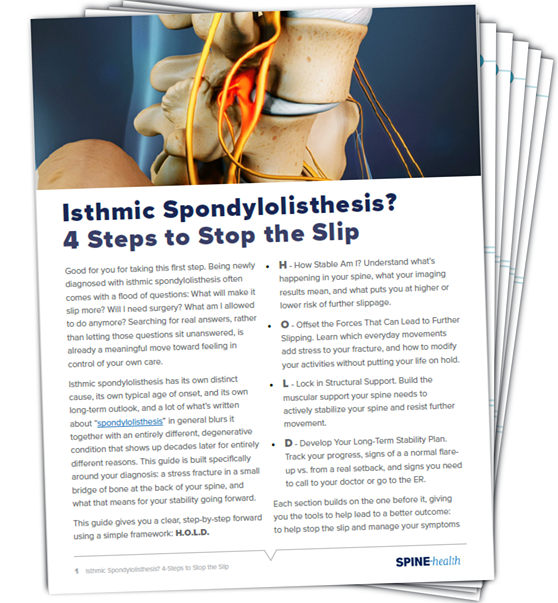
Isthmic Spondylolisthesis: 4-Steps to Stop the Slip
Isthmic Spondylolisthesis: 4-Steps to Stop the Slip
Just Diagnosed with Isthmic Spondylolisthesis? Here's How to Stop It From Slipping Further.
A 4-step, evidence-based plan built specifically for your diagnosis - not the degenerative condition most "spondylolisthesis" articles focus on.
If You're Sitting with a New Diagnosis, You Already Know This Feeling
You just heard the word "spondylolisthesis," and now the questions won't stop: What will make it slip more? Will I need surgery? What am I even allowed to do anymore?
So you searched for answers - and most of what you found didn't quite fit. It talked about aging discs, arthritis, people in their 60s. But you're not dealing with that. You're dealing with a small stress fracture in a bridge of bone at the back of your spine,

likely one that's been there since your teens or twenties, whether you knew it or not.
You deserve information built for your actual condition, not a general article that blurs it together with a completely different one.
GET YOUR STOP-THE-SLIP PLAN NOW - ONLY $29.95>
Why "Just Be Careful" Isn't a Plan
Here's what happens if those questions stay unanswered.
You start avoiding activities out of fear rather than fact - quitting a sport, skipping a workout, bracing every time you bend - not because you know it's risky, but because no one's told you which movements actually matter and which don't.
You read generic advice for "spondylolisthesis" that's really written for the degenerative version of the condition - different cause, different age of onset, different long-term outlook - and none of it quite applies to a stress fracture in the pars interarticularis.
Every flare-up brings the same fear: did I just make it worse? Without a way to track what's actually happening, one hard practice or one bad night's sleep feels indistinguishable from real progression.
And if you're a parent watching your teen go through this, the stakes feel even higher - you want a real answer, not "let's just see how it goes."
The longer this goes unaddressed, the more it costs: activities given up unnecessarily, or worse, activities continued without the modifications that actually protect the fracture.
GET YOUR STOP-THE-SLIP PLAN NOW>
Created by Spine-Health - Trusted by Millions for 25+ Years
This guide exists to answer both of your questions directly, using a structured 4-step framework: H.O.L.D.
It's built by the team behind www.spine-health.com - the leading source of unbiased, medically reviewed spine education, trusted by millions of patients and clinicians for over 25 years. We're not a surgical practice with a reason to push a procedure, and we're not a supplement company with something to sell you every month. We've spent two and a half decades doing one thing: translating complex spine conditions into information people can actually use - reviewed by doctors, written for patients.
GET YOUR STOP-THE-SLIP PLAN NOW>
What You'll Walk Away Knowing
Here's exactly what you'll walk away knowing:
- The real difference between isthmic and degenerative spondylolisthesis — and why so much of what's written online doesn't actually apply to you
- The four stages your pars fracture moves through, from stress reaction to full spondylolisthesis, and how to tell where you stand
- How to translate your own imaging report, so phrases like "bilateral pars defect" and "slip angle" stop being jargon and start being information you understand
- The specific risk factors that raise your odds of further slippage — including the ones that matter most if you're still growing
- Which sports and activities put the most stress on your fracture, and how to modify (not necessarily quit) the ones you care about
- Why flexion-based strengthening is the standard approach for this specific condition, and the deep stabilizer muscles to rebuild first
- A 4-stage progression that tells you exactly when to add difficulty and when to hold steady
- The difference between a normal flare-up and a genuine setback — so a hard practice or a bad night's sleep doesn't send you into a panic
- The specific red flags that mean "call your doctor today" versus the ones that mean "this is normal, keep going"
GET YOUR STOP-THE-SLIP PLAN NOW>
Common Questions, Answered Honestly
"Is this the same as the 'spondylolisthesis' guide for older adults?" No — and that distinction matters. Isthmic spondylolisthesis comes from a stress fracture, often formed in the teens or twenties, and behaves differently than the age-related, degenerative form that shows up decades later. This guide is built specifically for your version.
"I'm a teenager (or my child is). Is this guide still safe to use?" Yes, with one note: if you're still growing and this is a recent, acute fracture, your doctor may recommend a period of rest or bracing before starting any exercise progression. The guide covers this directly and explains when it's time to move from rest to rebuilding strength.
"I already have a doctor or physical therapist. Do I need this?" Yes - this isn't a replacement for your care team, it's what makes your appointments more productive. You'll walk in with a tracked history of your symptoms and specific, precise descriptions of what triggers them, instead of a general "it hurts during practice."
"What if my slip gets worse anyway?" No one can honestly promise it won't - and if anyone tells you otherwise, they're not being straight with you. What the evidence shows is that most young people with low-grade isthmic spondylolisthesis return to full, pain-free activity without surgery. This guide gives you a real, structured plan to put those odds in your favor.
GET YOUR STOP-THE-SLIP PLAN NOW>
What's Inside
When you get the guide today, here's everything included:
✔ The complete H.O.L.D. Guide - all 4 steps: How Stable Am I, Offset the Forces, Lock In Structural Support, and Develop Your Long-Term Stability Plan
✔ Illustrated Exercise Guide - detailed instructions and images for every stabilization exercise, with a guided progression you can bring to physical therapy
✔ Daily Activity Tracker - build your own personalized list of what to avoid, modify, and keep doing
✔ Daily Symptom Tracker - document pain, numbness, and activity tolerance so you have real data, not guesswork, for every appointment
That's a complete diagnostic framework, a full exercise program with images, and two tracking tools built specifically for this condition - not a single generic PDF.
Try It Risk-Free
If this guide doesn't help you understand your condition and give you a clear plan within 7 days, request a full refund - no questions asked.
GET YOUR STOP-THE-SLIP PLAN NOW>
Don't Wait for Uncertainty to Shrink Your World
Every week this stays unresolved is a week of avoiding activities you don't actually need to give up - or continuing ones without the modifications that would protect your fracture. And if you're still growing, this is genuinely your highest-risk window for further slippage, which makes understanding your risk factors now, not later, especially worth doing.
The sooner you understand what's actually happening in your spine, the sooner you can stop guessing and start following a real plan.
Get It Now
A single physical therapy co-pay often runs $30–$60. A single confused appointment with your doctor — where you can't clearly describe which movement triggers your symptoms — costs you time and clarity you don't get back.
This guide, plus all three bonus tools, is $29.95 - less than one PT co-pay, and less than the cost of ordering in dinner.
Isthmic Spondylolisthesis? 4-Steps to Stop the Slip - Instant PDF Download
Only $29.95 $39.95
Couldn't load pickup availability