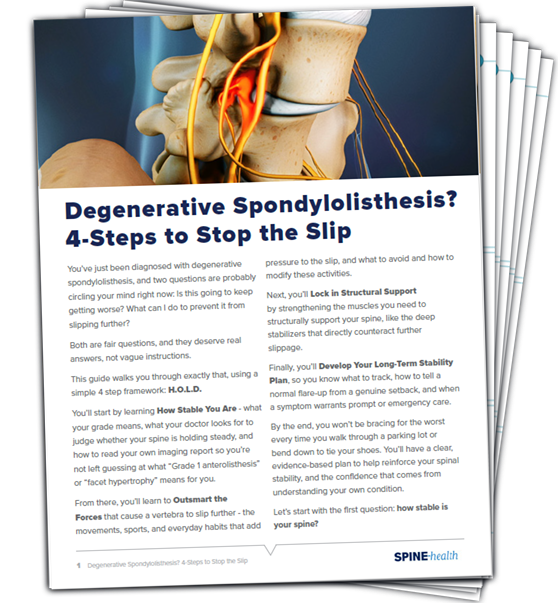
Degenerative Spondylolisthesis: 4-Steps to Stop the Slip
Degenerative Spondylolisthesis: 4-Steps to Stop the Slip
Just Diagnosed with Degenerative Spondylolisthesis? Here's How to Stop It From Slipping Further.
A 4-step, evidence-based plan for understanding your grade, protecting your spine, and building the stability to move without bracing for the worst.
If You're Sitting with a New Diagnosis, You Already Know This Feeling

You just got the diagnosis. Maybe your doctor said "Grade 1 anterolisthesis." Maybe you saw "degenerative" and "instability" on your chart and closed the portal before reading the rest.
Since then, two questions have been circling and won't stop: Is this going to keep getting worse? And what am I actually supposed to do about it?
You've probably been told the basics - watch your posture, don't overdo it, maybe some general exercises. None of that tells you what's actually happening in your spine, what specifically makes it worse, or what to do, in order, starting today.
GET YOUR STOP-THE-SLIP PLAN NOW - ONLY $29.95>
Why "Just Be Careful" Isn't a Plan
Here's what happens if those two questions stay unanswered.
You start bracing for the worst every time you bend down to tie your shoes, walk through a parking lot, or pick up a grandchild - not because you know it's dangerous, but because you don't know that it isn't.
You get vague advice like "avoid bending backward," but nobody tells you that means modifying your golf swing, your gardening posture, even how you sleep. So you either overcorrect and stop doing things you don't need to give up, or you keep doing the exact daily habits that are quietly adding pressure to the slip.
Every flare-up sends you into a spiral of "did I just undo everything?" - because without a way to track what's actually happening, one bad day feels the same as genuine progression.
And the longer this goes on without a real plan, the more your world quietly shrinks: fewer activities, more pain medication, less confidence in your own body. Not because your spine forced that on you - but because uncertainty did.
GET YOUR STOP-THE-SLIP PLAN NOW>
Created by Spine-Health - Trusted by Millions for 25+ Years
This guide exists to answer both of your questions directly, using a structured 4-step framework: H.O.L.D.
It's built by the team behind www.spine-health.com - the leading source of unbiased, medically reviewed spine education, trusted by millions of patients and clinicians for over 25 years. We're not a surgical practice with a reason to push a procedure, and we're not a supplement company with something to sell you every month. We've spent two and a half decades doing one thing: translating complex spine conditions into information people can actually use - reviewed by doctors, written for patients.
This guide takes that same approach and applies it specifically to degenerative spondylolisthesis: what your grade means, what's actually driving instability in your case, and the exact, evidence-based steps to help stop it from progressing.
GET YOUR STOP-THE-SLIP PLAN NOW>
What You'll Walk Away Knowing
Here's exactly what you'll walk away knowing:
- The real difference between your Meyerding grade and your actual risk of further slippage - and why they're not the same thing
- How to translate your own imaging report, so phrases like "facet joint hypertrophy" and "no significant translation on flexion-extension views" stop being medical jargon and start being information you understand
- The one movement pattern responsible for the majority of added pressure on a slipped vertebra - and it's probably not what you'd guess
- Which sports and hobbies are genuinely risky, which just need small modifications, and which are actually fine (yes, including some you've probably been avoiding unnecessarily)
- The deep stabilizer muscles research directly links to further slippage — and the specific daily exercise to reactivate them, starting this week
- A 4-stage progression that tells you exactly when to add difficulty and when to hold steady, so you're never guessing whether you're doing too much or too little
- The difference between a normal flare-up and a genuine setback — so a bad day stops meaning a bad week
- The specific red flags that mean "call your doctor today" versus the ones that mean "this is normal, keep going"
-
What "success" actually looks like with this condition (hint: it's not the complete absence of symptoms - and knowing the real markers changes everything about how you track your progress)
GET YOUR STOP-THE-SLIP PLAN NOW>
Common Questions, Answered Honestly
"I already have a doctor / physical therapist. Do I need this?" Yes - this isn't a replacement for your care team, it's what makes your appointments more productive. You'll walk in with tracked data, informed questions, and a clear sense of what to ask instead of vague descriptions of how you've been feeling.
"Is this just generic back pain advice repackaged?" No. This guide is built specifically around how degenerative spondylolisthesis behaves - what makes it uniquely worse (backward bending and shear force), what stabilizes it (specific deep stabilizer muscles), and how to track it. Generic back advice doesn't address any of that.
"What if my spine gets worse anyway?" No one can honestly promise it won't — and if anyone tells you otherwise, they're not being straight with you. What the evidence shows is that 80–85% of patients manage this condition without surgery, and most stabilize and stay that way for years. This guide gives you a real, structured plan to put those odds in your favor.
"I'm not someone who exercises regularly. Is this too advanced for me?" No. The H.O.L.D. framework starts at Stage 1: simple activation exercises done lying down, with no equipment. It's built for people starting from zero, not people already in a routine.
GET YOUR STOP-THE-SLIP PLAN NOW>
What's Inside
When you get the guide today, here's everything included:
✔ The complete H.O.L.D. Guide - all 4 steps: How Stable You Are, Offset the Forces, Lock In Structural Support, and Develop Your Long-Term Stability Plan
✔ Illustrated Exercise Guide - clear explanations and images for every stabilization exercise, plus bonus positions and stretches for leg pain relief
✔ Daily Activity Tracker - build your own personalized list of what to avoid, modify, and keep doing
✔ Daily Symptom Tracker - document pain, numbness, and walking tolerance so you have real data, not guesswork, for every appointment
That's a complete diagnostic framework, a full exercise program with images, and two tracking tools built specifically for this condition - not a single generic PDF.
Try It Risk-Free
If this guide doesn't help you understand your condition and give you a clear plan within 7 days, request a full refund - no questions asked.
GET YOUR STOP-THE-SLIP PLAN NOW>
Don't Wait for Uncertainty to Shrink Your World
Every month this stays unresolved is a month of bracing instead of moving with confidence - and a month where the everyday habits quietly adding pressure to your slip (how you sleep, how you lift, how you stand) keep happening on repeat, simply because no one's told you which ones matter.
The sooner you understand your specific risk factors, the sooner you can start offsetting them. There's no reason to wait for your next appointment to start.
Get It Now
A single physical therapy co-pay often runs $30–$60. A single confused, unproductive appointment with your doctor - where you can't clearly describe what's working and what isn't - costs you time you don't get back.
This guide, plus all three bonus tools, is $29.95 - less than one PT co-pay, and less than the cost of ordering in dinner.
Degenerative Spondylolisthesis? 4-Steps to Stop the Slip - Instant PDF Download
Only $29.95 $39.95
Couldn't load pickup availability